
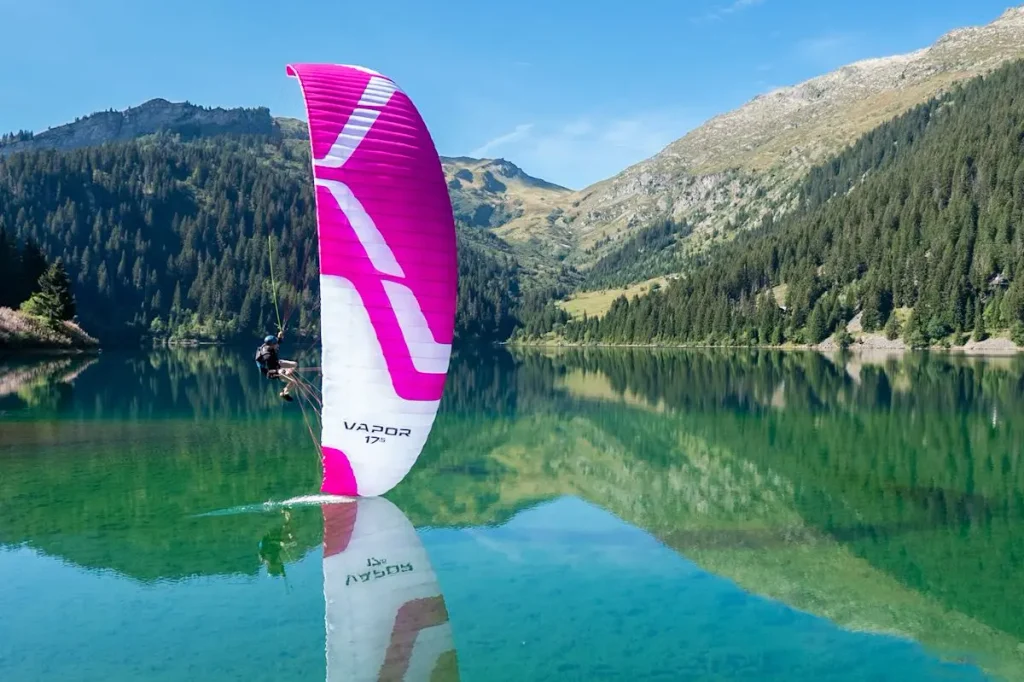
A new way into flying New
New for October 2026, and developed with the BHPA: our Parakite Training Course leads to the brand-new Parakite Club Pilot rating. It's built for anyone who wants to learn specifically to parakite, so you can skip the traditional paragliding hill training altogether.
Whether you're an experienced kitesurfer, a skydiver who already knows how to handle a canopy, or completely new to all of it, this route gets you flying faster. Already a paraglider pilot? We also run a conversion course for you.
What is a parakite?
A parakite is a type of paraglider: a foot-launched ram-air wing with a reflex profile and a dedicated control system. It isn't simply a small paraglider with unusual risers, and parakites aren't necessarily small.
On a paraglider you fly mainly with the brakes, which act on the trailing edge. On a parakite, an integrated control system changes the geometry of the risers, so you control the wing's angle of attack directly: slow and nose-up with the controls pulled, fast and nose-down with them let up, with the reflex profile keeping the wing stable. That gives a very wide speed range and a direct, dynamic feel that suits stronger coastal wind.
We teach the course on the coast, including Cornwall, choosing the site each day to suit the wind.
It's not all low-level wagas and foot-dragging along the beach, though. You can still soar gently like a paraglider, and the bigger wind range means far more flyable days.
Want the full picture first? Read our guide to parakiting in the UK: the BHPA rules and insurance, where to fly, rotor safety and choosing your first wing.
Three levels of wing
- Beginner: built for maximum passive safety, predictable behaviour and forgiving recovery, for students starting from scratch.
- Intermediate: for pilots with solid control, or paraglider pilots crossing over. This level is fine for experienced paraglider pilots.
- Advanced: for expert pilots who want high performance, speed and agility.
What you'll learn
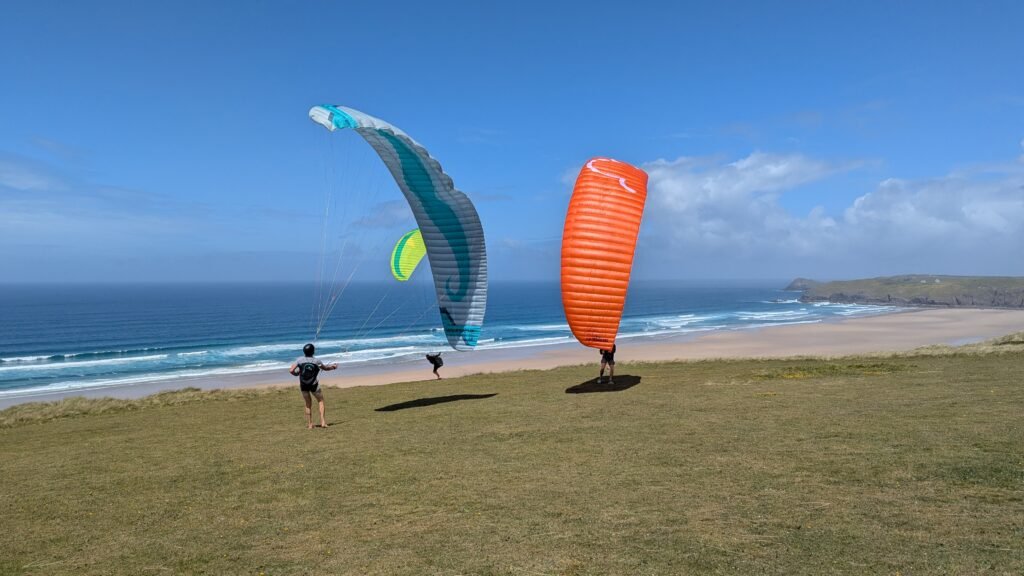
- Ground handling: pre-flight checks, site assessment and equipment handling, including forward, reverse and cobra inflations. You'll learn to run with the canopy, launch in strong wind, land under control and depower the wing quickly so it doesn't drag you or reinflate.
- Flying: flying in stronger winds, understanding the wind window, and learning to fly with the parakite's control system.
- Theory: meteorology, principles of flight and air law, plus ridge rules, collision avoidance and soaring the coast in strong winds, so you can make safe decisions on your own.
When you pass you'll hold the BHPA Club Pilot rating for parakites, which lets you fly independently in a club environment. You also get full access to our e-learning platform.
Ready to buy your first parakite?
We provide all the kit you need for training. When you want your own, the Sky Riders shop has our recommended parakites at all three levels, and Sky Riders students get exclusive bundle discounts.
Questions
Parakite course FAQs
What's the difference between a parakite and a paraglider?
A paraglider is built to glide efficiently over long distances. A parakite is a reflex paraglider wing with a dedicated control system that changes the wing's angle of attack, giving a much wider speed range for coastal flying in stronger winds. You can still soar gently, but you can fly on windier days and it feels much more dynamic.
Do I need paragliding experience to learn to parakite?
No. This course is built for people learning from scratch, so you skip the usual paragliding hill training. Kitesurfers and skydivers with canopy skills often pick it up quickly, but none of that is required.
I already paraglide. Can I convert?
Yes. We run a conversion course for paraglider pilots trying parakites for the first time. Get in touch and we'll talk through what you need.
How long does the course take?
About 7 days of training, depending on the weather. You have 12 months from your start date to finish.
Do I need my own parakite?
No, we provide the kit for your training. When you're ready to buy, our shop stocks recommended wings at all three levels, with discounts for Sky Riders students.
Other courses
You might also like
Taster Day
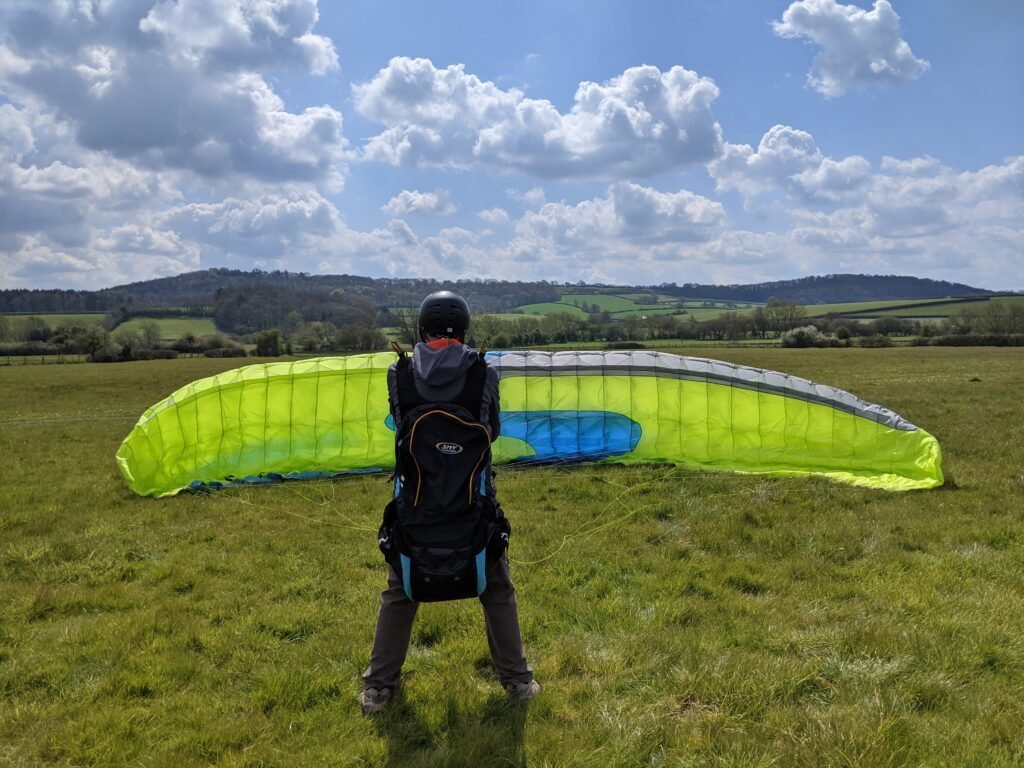
Day one of your training, with no commitment. Meet the team, handle a wing and maybe leave the ground. If you carry on, it counts as your first day and the £250 comes off your course fee.
View course →
Paragliding Club Pilot (Hill)
Learn to soar, top land and fly alongside other pilots on the Jurassic Coast, so you can fly without an instructor at club sites.
View course →
Paramotor Club Pilot
From complete beginner to flying solo under power in Somerset, with no separate EP course needed. Launches, landings, engine-out practice and airspace.
View course →Contact
Book your parakite course
Tell us about any kite, canopy or flying experience you have, and roughly when you'd like to train.
- Phone
- 07599 844 678
- Message us on WhatsApp
- fly@sky-riders.co.uk
- Training
- Sites across Somerset, Dorset, Devon and Cornwall
- Workshop
- Royal Bath & West Showground, Shepton Mallet, Somerset BA4 6QN