Parakiting in the UK is a new and growing way to fly. You fly a reflex paraglider wing with a dedicated control system, often from coastal sites in winds that would ground most paragliders. This guide covers what a parakite is, the BHPA rules and insurance, how to learn, where to fly and how to stay safe.
What is a parakite?
A parakite is a type of paraglider: a foot-launched ram-air wing, but with a reflex profile and a dedicated control system. It isn’t simply a small paraglider with unusual risers, and parakites aren’t necessarily small.
The difference is how you control it. On a paraglider you fly mainly with the brakes, which act on the trailing edge. On a parakite, an integrated control system changes the geometry of the risers, so you control the wing’s angle of attack directly. Pull the controls and the wing pitches nose-up and flies slowly. Let them up and it pitches nose-down and flies fast, with the reflex profile keeping it stable and resistant to frontal collapses.
The result is a very wide speed range and a direct, dynamic feel, which is why parakites suit stronger coastal wind. For a detailed explanation of how the control system works, see this guide from flyparakite.com.
| Paraglider | Parakite | Mini wing | Speed wing | |
|---|---|---|---|---|
| Main use | Soaring, thermalling, cross-country | Dynamic flying, especially in stronger coastal wind | Hike and fly, soaring, fast descents | Speedflying and speedriding down mountains |
| Feel | Stable, efficient glide | Direct and dynamic; speed controlled through angle of attack, with a reflex profile | Faster and more responsive than a paraglider | Very fast, little glide |
| Typical sites | Inland hills and coast | Coastal dunes and cliffs | Hills and coast | Mountains and snow slopes |
Parakites come in three broad levels. Beginner wings have the most passive safety and forgiving recovery. Intermediate wings suit pilots with solid wing control, or paraglider pilots crossing over. Advanced wings are built for speed, agility and performance.
Is parakiting in the UK legal and insured?
Yes. In the UK, parakites come under the British Hang Gliding and Paragliding Association (BHPA), which governs paragliding and provides members’ third-party insurance.
If you’re already a paraglider pilot: BHPA members with a paragliding Club Pilot rating are currently insured to fly a parakite. But a parakite behaves very differently from a paraglider, especially in strong wind and at speed. Before you fly one, we strongly recommend talking to a BHPA club coach or instructor, and getting proper guidance on the wing and the sites you plan to fly.
If you’re new to flying: the BHPA is trialling a dedicated Club Pilot rating for parakites, so you can learn to parakite from scratch without doing hill paragliding training first. Only three BHPA schools are part of the trial, and Sky Riders is one of them. Pass the course and you hold a BHPA Club Pilot rating for parakites, which lets you fly independently in a club environment.
As with all BHPA flying, parakiting in the UK needs BHPA membership (which includes your third-party insurance) and the agreement of whoever manages the site you fly.
How to learn to parakite
There are three routes in, depending on where you’re starting from.
| You are… | Route | What to expect |
|---|---|---|
| New to flying | Parakite Club Pilot course | About 7 weather-dependent days, from scratch, with no hill paragliding training first. Minimum age 18. |
| A kitesurfer or skydiver | Parakite Club Pilot course | Your wind sense or canopy skills help you pick up wing handling quickly. The course fills the flying knowledge kitesurfing doesn’t teach: rotor, air law, ridge rules and site assessment. |
| A paraglider pilot | Conversion course, or guidance from a coach | You’re already insured to fly a parakite as a BHPA Club Pilot, but the wing is very different. Talk to a club coach or instructor first, or do a conversion course. |
What the course covers
- Ground handling: pre-flight checks, site assessment, forward, reverse and cobra inflations, launching in strong wind, controlled landings, and depowering the wing quickly.
- Flying: flying in stronger winds, understanding the wind window, and learning to fly with the parakite’s control system.
- Theory: meteorology, principles of flight, air law, ridge rules, collision avoidance and coastal soaring in strong wind.
At Sky Riders the Parakite Club Pilot course costs £1,500. That includes instruction, all training kit and access to our e-learning, with a maximum of 4 students per instructor. You have 12 months to complete it. Not sure yet? A taster day (£250) counts as day one, and the fee comes off the course price if you continue.
Where to go parakiting in the UK
Parakites are at their best on coastal sites: sand dunes and cliffs facing a steady sea breeze. Two of the UK’s best-known spots are Perranporth in Cornwall and Rhossili on the Gower in South Wales.
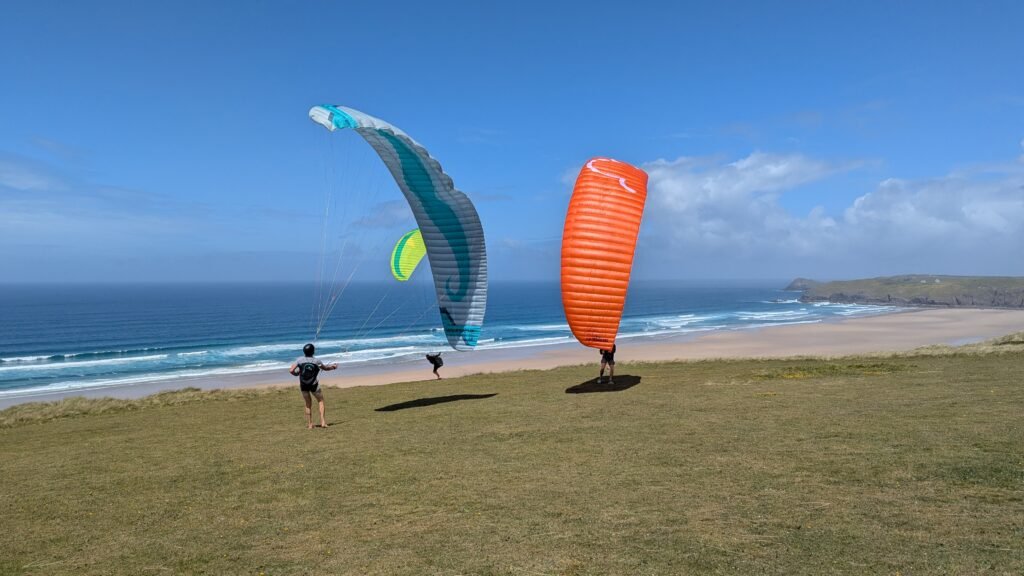
Parakites aren’t necessarily suitable for every site. Most UK flying sites are looked after by local BHPA clubs under agreements with landowners, and each has its own rules. Always check with the local club before you fly a parakite on their site. Ask whether parakites are allowed, which wind directions and conditions work, and where the landing areas, hazards and no-fly zones are.
Staying safe: rotor, strong wind and the coast
Parakites let you fly in stronger wind, and that’s exactly where the biggest risks are.
- Rotor: wind flowing over a dune, cliff edge, building or any obstacle becomes turbulent behind and below it. Rotor can collapse a wing or throw you into the ground without warning. Understanding where it forms and staying out of it is the most important safety skill in parakiting. It’s also the one most often missing for people coming from kitesurfing.
- Strong wind: know your wing’s limits and your own, and have a plan to depower and land before conditions build.
- Getting blown back: in strong wind you can be carried behind the ridge into rotor and turbulence. Keep your penetration in mind at all times.
- The coast itself: tides, cliffs, the sea, walkers, dogs and other beach users all need space and attention.
Flying low, and why height is just as much fun
Parakites are often flown dynamically, close to the ground and close to the dunes. That’s where the risks are highest: there’s less time and space to recover from a mistake, and you’re often near walkers and beach users. Low, fast passes can also be unnerving for the public, which matters for keeping sites open.
You don’t have to fly low to enjoy a parakite. Flying at height is just as much fun, and you still get the parakite’s speed, agility and dynamic flying style, with far more margin for error. Pilots who fly low, and do it well, generally have years of experience: many came from flying wagga-style on paragliders, or built up to it slowly over a long time. Start high, and work down gradually as your skills and experience grow.
This is why we recommend proper training, or guidance from a BHPA coach, rather than teaching yourself.
Choosing your first parakite
Choose a beginner-level wing with high passive safety for your first parakite, even if you’re an experienced paraglider pilot. The right size depends on your weight, your experience and the wind you’ll usually fly in, so get advice before you buy rather than going by weight range alone.
We’re a dealer for several parakite brands and stock wings from Ozone, Phi, Little Cloud, BGD, Flow and Niviuk. See the parakites in our shop, or ask us to help you choose. Once you’re flying, your wing can be serviced and trimmed at our Wingtrim service centre.
How much does parakiting in the UK cost?
Here’s what to budget for at Sky Riders. Training kit is included on the course, so you don’t need your own wing to start.
| Item | Cost |
|---|---|
| Taster day (counts as day one of the course) | £250 |
| Parakite Club Pilot course, including training kit and e-learning | £1,500 |
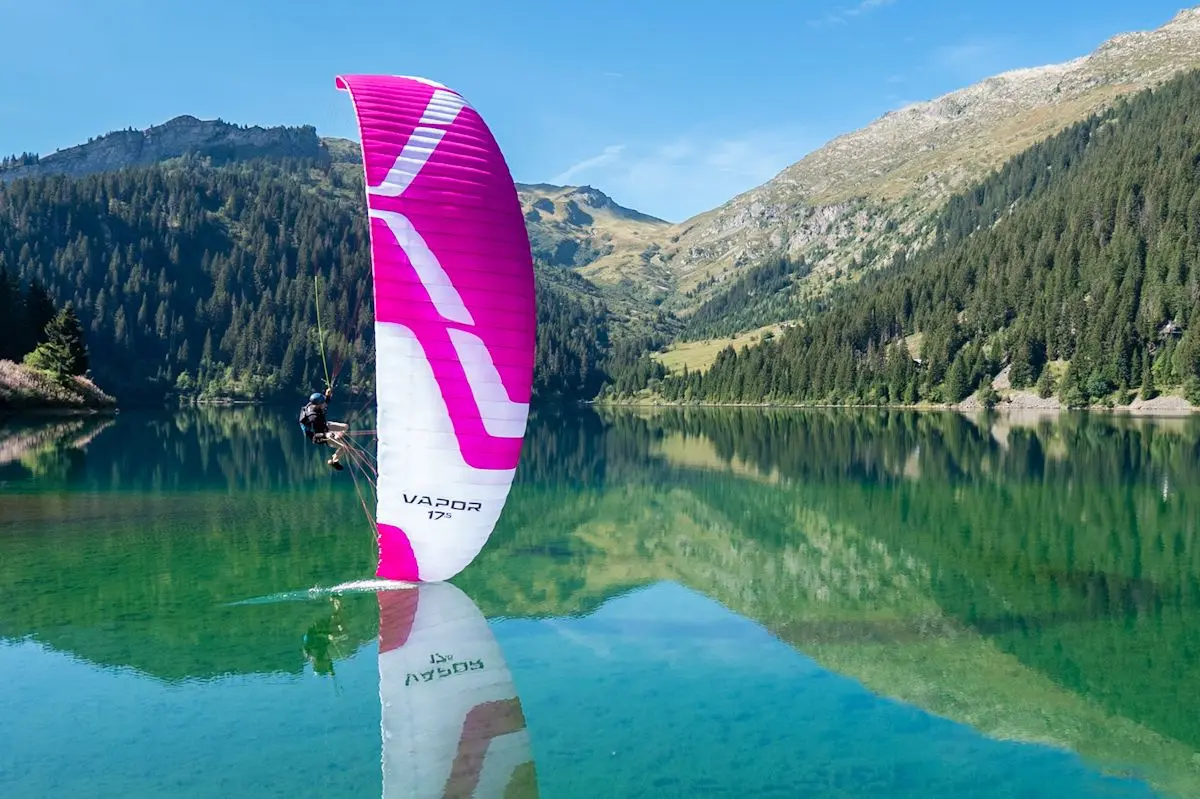
| Your own parakite, e.g. Ozone Vapor, Phi Rowdy, Little Cloud Fregate | From about £2,800 |
| Parakite service and trim at Wingtrim | From £125 |
| BHPA membership, including third-party insurance | See the BHPA website |
You’ll also need a harness suited to parakiting and a helmet. Ask us about bundle discounts on kit when you train with us.
Start parakiting in the UK with Sky Riders
- Parakite Club Pilot course: £1,500, about 7 days
- Book a taster day: £250, counts as day one
- Parakites in the shop
- Parakite service and trim at Wingtrim
- Questions? Call 07599 844 678, WhatsApp us or email fly@sky-riders.co.uk.